


Surrogacy: A Route To Parenthood In Ireland
- The current status of Surrogacy in Ireland
- Developments in Irish Surrogacy legislation
- What you need to know about Domestic Surrogacy in Ireland
- Helpful guidelines when considering Surrogacy overseas
- The Irish Court Process
- Plus, much, much more...
Just fill in your details opposite to download a free copy or alternatively you can read the complete guide by scrolling down this page.
Get The Guide
Surrogacy In Ireland
The Assisted Human Reproduction Bill has now passed through all stages in the Oireachtas. After many years of work to make this a reality, Ireland now has a robust legal framework for children born through both domestic and international surrogacy.
The Bill will finally be enacted into Irish law once it is signed by President Michael D Higgin and is a momentous occasion for anyone interested in alternative routes to parenthood in Ireland.
Based upon this important milestone in the regulation of surrogacy in Ireland, we have published the 6th edition of our popular ebook, “Surrogacy: A Route To Parenthood In Ireland” in an attempt to help intending parents to learn more about the process and ensure they can make informed decisions on their best next steps.
If you would like to discuss any surrogacy related questions you may have, please do not hesitate to get in touch, read or download a copy of our free ebook on this page, or visit our comprehensive resource section for more.
General Information
When a child is born via surrogacy, whether in Ireland or oversees, the surrogate is recognized as the only parent and automatic guardian of the child at birth. If she is married there is a presumption that her husband is the child’s father.
There are currently no international agreements which govern the minimum standards surrogacy arrangements must meet. Any intending parent considering pursuing an international surrogacy journey must remember that they and any child born as a result of a surrogacy arrangement will in Ireland be subject to Irish law.
Pre enactment of legislation -
the legal status of parties:
After the enactment and commencement of past surrogacy provisions in legislation: The legal status of parties:
If the surrogate is married her husband continues to be presumed to be the father of the child until a DNA test proves that the intending father is the biological father. The legislation does include provisions that remove this presumption after the AHRRA is established in international surrogacy arrangements.
The legislation does not include any provisions which provide any detail regarding maternity benefit, maternity leave or the entitlement of intending parents to social protection or employment protection after the legislation is enacted and commenced.
Domestic Surrogacy
There are currently no residence requirements for the intending parents or a surrogate when a Declaration of Parentage application is listed before the Irish Court. The child must be habitually resident in Ireland in order for an application for a Guardianship Order to be listed.
The past surrogacy arrangement provisions require that both the surrogate and intending parents must be for not less than one year (or such longer period as may be prescribed) habitually and lawfully resident in Ireland prior to entering into a surrogacy agreement. After the Assisted Human Reproduction Regulatory Authority is established the resident requirements increase from one to two years.
The embryo transfer for all but very few domestic surrogacy arrangements currently take place in fertility clinics outside of Ireland. After the birth of the baby, the surrogate together with the biological father can apply to have both of their names listed on the birth certificate.
Domestic Surrogacy Arrangements
Both parties should have received independent legal advice prior to signing a domestic surrogacy agreement. The responsibility and obligations of the parties to a domestic surrogacy agreement are not enforceable in an Irish Court.
The process of discussing and agreeing the terms of the agreement concentrates the intending parents’ minds and the surrogates mind regarding the various issues that could occur, encourages discussion between the parties and ensures that before the domestic surrogacy agreement is signed, all parties are in full agreement regarding all possible issues and matters that could arise throughout the surrogacy before any treatment has commenced.
The Court will, subject to the application complying with the legislative provisions, receipt of the required consents to the application and after judging the order to be in the best interests of the child, grant the parental order to the intending parents. The effect of the grant for parental order is the transfer of parentage of the child from the surrogate to the intending parents.
Where the biological father has applied for and received his Declaration of Parentage previously from the Court, the grant of the parental order to the intending parent will not affect his order or parental relationship with the child. The application for parental orders pursuant to the “past domestic surrogacy arrangement provisions in the legislation must be listed before the Court no later than three years from the date of commencement of the provision or six months from the date of birth of the child, whichever is the later.
This means that if the application is not listed within that time period, the application for a parental order cannot thereafter be applied for.
After the AHRRA has been established a pre-conception approval authorization will be required from the AHRRA before the parties can proceed with a permitted surrogacy arrangement.
International Surrogacy
International Surrogacy
If your baby is entitled to a passport from the country of birth, your lawyer in that country should provide you with advice and guidance on the procedure that needs to be followed in order to apply for that passport. Its important that its clarified whether there are any Irish immigration visa requirements that you need to comply with.
If your baby will need an emergency travel certificate from the Department of Foreign Affairs its essential that you have read the guidance document for Irish couples pursuing surrogacy arrangements abroad published in 2012 by the Department of Justice. The biological parent must be an Irish citizen. If the biological parent is not an Irish citizen they are not eligible to apply for an ETC for their baby.
Each application to the Department of Foreign for an ETC is reviewed by the Department of Foreign Affairs on its own merits and own factual situation. The Department of Foreign Affairs will issue their documentary requirements to intending parents. If the biological father is an Irish citizen but was not born in Ireland the baby’s birth must be registered with the foreign birth registration after the Irish Court order is granted before an application for an Irish passport will be processed.
The baby’s birth certificate will issue from the registrar in the surrogacy jurisdiction where the baby is born. The birth certificate from the surrogacy jurisdiction is not recognised as legal proof of parentage in Ireland. Birth certificates can name the surrogate and biological father or both intending parents. This varies and is dependent on the local law and regulations in the surrogacy jurisdiction.
Intending parents should have written confirmation before they start their international surrogacy journey of who will be responsible for obtaining their babies birth certificate, translating, notarizing and apostilling documents, arranging attendance of the surrogate at the DNA test (if applying for an ETC), supporting you with finalising and submitting the necessary documentation to the Department of Foreign Affairs for an ETC.
Agencies & Intermediaries
If your agency representative suggests that you seek legal advice from a particular lawyer you need to get confirmation that the suggested lawyer is not associated or connected with the agency in any way and hasn’t previously and doesn’t currently benefit from any financial arrangement with the agency.
You can’t take at face value what you read about an agency or intermediary, unfortunately some of the posts and testimonials from parents on the agency’s website or in the various forums may have been generated by the agency themselves.

We're Here To Help!

A Patient's Guide To Medical Negligence In Ireland
If you think you (or someone close to you) have suffered an injury due to medical negligence, please download our free guide to understand more about the options available to you.
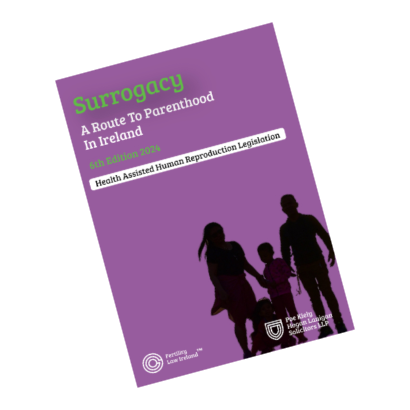
To assist couples interested in exploring Surrogacy we have prepared a useful guide
Surrogacy: A Route To Parenthood In Ireland
This guide is now in its sixth edition and is free to read online or download by clicking on the link below.
a) Will she be asked to share with other surrogates?
b) Will her children (if she has children) be with her, if not, what childcare arrangements are being made for the care of her children?
c) Provide confirmation that the accommodation has been assessed as being suitable for a pregnant woman, for example, access to medical care facilities, access to transport to go to hospital, lifts within the accommodation, stairs, etc.
This biological link is essential before the intending parents can apply to list an application to the Court for parental orders.
The responsibilities and obligations of intending parents and surrogates as detailed in an international surrogacy agreement are not enforceable in Ireland.
After the establishment of the AHRRA all surrogacy arrangements must be altruistic. Commercial surrogacy arrangements are prohibited. The surrogate should only receive reimbursement of her reasonable expenses associated with becoming or trying to become pregnant, pregnancy or birth and entering into a surrogacy arrangement.
An expense is reasonable if it’s actually incurred and the amount of the expense can be verified by receipt or other documentation.
The child must be habitually resident in Ireland in order for an application for a Guardianship Order to be
listed. The past international surrogacy arrangement provisions require that the surrogate must be for not less than one year (or such longer period as may be prescribed) habitually and lawfully resident in the surrogacy jurisdiction prior to entering into a surrogacy agreement and the intending parents must be for not less than one year habitually and lawfully resident in Ireland.
After the AHHRA is established the resident requirements increase from one to two years.
The effect of the grant for parental order is the transfer of parentage of the child from the surrogate to the intending parents. Where the biological father has applied for and received his Declaration of Parentage previously from the Court, the grant of the parental order to the intending parent will not affect his order or parental relationship with the child.
The application for parental orders pursuant to the “past international surrogacy arrangement provisions in the legislation must be listed before the Court no later than three years from the date of commencement of the provision or six months from the date of birth of the child, whichever is the later.
This means that if the application is not listed within that time period, the application for a parental order cannot thereafter be applied for.
THE COSTS OF ASSOCIATED WITH AN INTERNATIONAL SURROGACY ARRANGEMENT INCLUDE THE FOLLOWING:
(a) Hospital fees, pre natal care.
(b) Health or medical insurance for the surrogate.
(c) NICU insurance for baby.
We are acutely aware that intending parents need clear, transparent advice on Irish legal fees and costs as soon as is possible. After we have an initial consultation with intending parents and have a clear understanding of the legal service, guidance and advice required we will provide the intending parents with a letter explaining the legal fees that we will charge for the services that we will provide and at what stage during the process payment will be requested.
The Court Process
Pending the enactment and commencement of legislative provisions that provide for applications to the High Court for parental orders for intending parents the issue of legal parentage of children born through surrogacy involves an application to the Irish Court under other family law legislation. The application must include a DNA test result evidencing the biological link between the child and the biological father. The surrogate cannot be biologically related to the child.
The biological father applies for a declaration of parentage, guardianship and custody orders and also an order dispensing with the necessity to seek the surrogate’s consent to the issuance of an Irish passport for the child. The Court proceedings are served on the surrogate, her husband (if she is married), their independent lawyer and the Irish Chief State Solicitors office. If the surrogate’s native language is not English the proceedings must be translated into her native language by a certified translator before they are explained to her by her independent lawyer. The Chief State Solicitors Office represents the Attorney General in the court proceedings. After service of proceedings on the Chief State Solicitors office they will issue a list of the documents and proofs that they require. Currently these applications can be listed in the Circuit Court or the High Court.
The second intending parent (non biological parent) can not apply for a declaration of parentage. After the second parent has shared the day to day care and rearing the child with the biological parent they can apply to the Court to become a guardian of the child.
Past surrogacy arrangements - both the agreement with the surrogate has been signed and the embryo transfer must has taken place before these provisions commence.
These applications will be listed before the High Court. The application must include a DNA test result evidencing the biological link between the child and at least one of the intending parents. The surrogate cannot be biologically related to the child.
The intending parents apply for parental orders. The Court proceedings are served on the surrogate, her independent lawyer and the Irish Chief State Solicitors office.
If the surrogate’s native language is not English the proceedings must be translated into her native language by a certified translator before they are explained to her by her independent lawyer. The Chief State Solicitors Office represents the Attorney General in the court proceedings. After service of proceedings on the Chief State Solicitors office they will issue a list of the documents and proofs that they require.
The consent must be voluntarily given and only after the person has received independent legal advice about the legal implications of giving such consent. The Court may waive the consent requirement if the person is deceased, can’t be located after reasonable efforts have been made or the person lacks the capacity to provide consent.
In considering what is in the child’s best interest the Court will have regard to the child’s age, maturity, the physical, psychological and emotional needs of the child, the likely effect of the granting of the parental order on the child, the child’s social, intellectual and educational needs, the child’s upbringing and care, the child’s relationship with his or her intending parents and any other particular circumstances pertaining to the child.
Where the biological father has applied for and received his Declaration of Parentage previously from the Court, the grant of the parental order to the intending parent will not affect his order or parental relationship with the child.
The application for parental orders pursuant to the past surrogacy arrangement provisions in the legislation must be listed before the Court no later than three years from the date of commencement of the provision or six months from the date of birth of the child, whichever is the later.
This means that if the application is not listed within that time period, the application for a parental order cannot thereafter be applied for.
The application for a parental order must be made not later than three years after the commencement of the provision in the Act or six months from the birth of the child, whichever is the later. This time can be extended by Court if there are exceptional circumstances or so doing or it is in the best interests of the child.
Note: This section does not include detail about the parental order process for permitted surrogacy arrangements following pre conception approval after the Assisted Human Reproduction Regulatory Authority has been established
The Assisted Human Reproduction Regulatory Authority ("AHRRA")
The AHRRA may after consultation with the Minister for Health and Minister of Foreign Affairs by order approve a surrogacy jurisdiction in which international surrogacy may be undertaken.
The intending parents must undertake that they will apply to the Court for a parental order in respect of any child born pursuant to the surrogacy agreement.
After a Parental Order has been granted, the Court will provide a copy of the Order to the AHRRA who will make an entry in the National Surrogacy Registrar. The entry in the registrar shall contain information in respect of the child, the surrogate, donor (if relevant) and the parents.
In Summary
It has been our privilege to work with and get to know so many amazing parents, intending parents, members of advocacy groups and politicians who have all worked tirelessly during the last number of years to introduce a legislative framework in Ireland that will be ethical, ensure all surrogates are protected from exploitation and all children are treated equally.
I hope this guide assists and helps parents through surrogacy and intending parents understand and plan for the process of undertaking a surrogacy arrangement. I hope it helps inform intending parents of issues that may arise and to plan accordingly. This guide is not a substitute for professional or legal advice by intending parents both in Ireland and in the surrogacy jurisdiction.
Please complete the form below and we will be in touch to organise an appointment to discuss your situation.